Download Japan-U.S. Relations: Issues for Congress PDF by Emma Chanlett-avery
PDF Relations: Issues for Congress - EveryCRSReport
Relations: Issues for Congress Congressional Research Service Summary Japan is a significant partner for the United States in a number of foreign policy areas, particularly in terms of security priorities, from hedging against Chinese military modernization to countering threats from North Korea
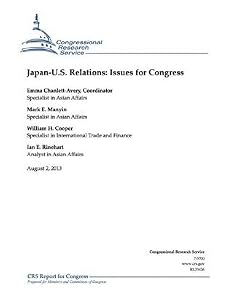
| Title | Japan-U.S. Relations: Issues for Congress |
| Durations | 47 min 39 seconds |
| Pages | 123 Pages |
| File | japan-us-relations-i_jgRVM.epub |
| japan-us-relations-i_l98eV.aac | |
| Published | 0 day ago |
| Quality | Sonic 96 kHz |
| File Size | 1,186 KiloByte |

Japan-U.S. Relations: Issues for Congress
| Category | Crafts, Hobbies & Home, History, Education & Teaching |
| Author | Emma Chanlett-avery |
| Publisher | John Bolton |
| Published | 2013 |
| Writer | Brandon Turner, Dzung Lewis |
| Language | Yiddish, Korean, Middle English |
| Format | Kindle Edition, pdf |
Relations: Issues for Congress
Relations: Issues for Congress Congressional Research Service Summary Japan is a significant partner of the United States in a number of foreign policy areas, including addressing regional security concerns, which range from hedging against Chinese military modernization to countering threats from North Korea
Relations: Issues for Congress
The -Japan announcement on September 26, 2018, of their intent to begin formal bilateral trade agreement negotiations has eased concerns over potential import restrictions on motor vehicle and parts trade, but certain steel and aluminum imports from Japan remain subject to increased tariffs. The trade talks could prove
Relations: Issues for Congress
Relations: Issues for Congress Congressional Research Service Summary Japan is a significant partner of the United States in a number of foreign policy areas, particularly in security concerns, which range from hedging against Chinese military modernization to countering threats from North Korea
Report to Congress on Relations - USNI News
Among his biggest challenges is hosting the 2021 Summer Olympic Games amidst a global pandemic. The Games were postponed in 2020 as COVID-19 began spreading. Relations: Issues for Congress; April 6, 2021 Contributed by Sam LaGrone ( Naval Institute) p. 1 1 of 47 Download the document here
Where to get Japan-U.S. Relations: Issues for Congress Ebook?
PDF Relations: Issues for Congress - NCNK
Relations: Issues for Congress Congressional Research Service 5 liberating much of East Asia from Western colonial powers, that the 1946-1948 Tokyo War Crimes tribunals were illegitimate, and that the killings by Imperial Japanese troops during the 1937 "Nanjing massacre" were exaggerated or fabricated
Relations: Issues for Congress - EveryCRSReport
Japan is worried about the commitment to its security given Trump's skepticism about alliances overseas, and concerned that the Administration will demand steep increases from Japan in next year's burden-sharing negotiations. Contentious trade issues have also resurfaced
PDF Relations: Issues for Congress
Relations: Issues for Congress Congressional Research Service 2 The Global Financial Crisis and Economic Downturn The and Japanese economic agendas are likely to be dominated by the efforts of the two countries to resolve the financial crisis and the sharpest recessions each has seen since the end of World War II
Updated March 30, 2022 -Japan Relations - Congress
Japan, a treaty ally since 1951, is a significant partner of the United States in several foreign policy areas, particularly security and trade. Shared security goals range from meeting the challenge of an increasingly powerful China to countering threats from North Korea. The - Japan mutual defense treaty grants the United States the
How to download Japan-U.S. Relations: Issues for Congress AudioBook?
Relations: Issues for Congress
-Japan relations have been adjusting to the Democratic Party of Japans DPJ landslide victory in the August 30, 2009 elections for the Lower House of Japans legislature. The victory gave the DPJ, under party president Yukio Hatoyama, control of the government
PDF Relations: Issues for Congress - EveryCRSReport
Relations: Issues for Congress Congressional Research Service 1 Recent Developments Abe Wins Victory in Snap Election On December 14, Prime Minister Shinzo Abe led his Liberal Democratic Party (LDP) to victory in elections for the Lower House of Japan's Parlia ment (called the Diet)
Relations: Issues for Congress - DTIC
In recent years, opposition control of one chamber of parliament has paralyzed policymaking in Tokyo and made -Japan relations difficult to manage despite overall shared national interests. Abe is unlikely to pursue controversial initiatives before the next national elections for the Upper House of parliament in July 2013
Relations: Issues for Congress
-Japan relations have been adjusting to the Democratic Party of Japan's (DPJ) landslide victory in the August 30, 2009 elections for the Lower House of Japan's legislature. The victory gave
Where to get Japan-U.S. Relations: Issues for Congress PDF?
Relations With Japan - United States Department of State
The United States and Japan cooperate on a broad range of global issues, including development assistance, global health, environmental and resource protection, and women's empowerment. The countries also work together to promote integrity in Information and Communications Technology supply chains and to ensure a secure transition to 5G networks
relations: issues for Congress. - Free Online Library
(2) Frustration with the lack of progress has led some industry groups and Members of Congress to argue that the proposed TPP should be concluded without Japan if Japanese negotiators are unwilling to make sufficient concessions, particularly on autos and agriculture, the two most challenging aspects of the bilateral talks
PDF Relations: Issues for Congress - UNT Digital Library
Relations: Issues for Congress Congressional Research Service 4 Act of 2015, which would renew TPA, was introduced in the House ( 1890) and Senate (S. 995) on April 17 and 16, respectively.6(See "Bilateral Trade Issues" section for more details.) Opposition to Base Relocation in Okinawa
Product Details RL33436 - Congress
Relations: Issues for Congress Report#: RL33436 Author(s): Emma Chanlett-Avery, Mark E. Manyin, Brock R. Williams, Caitlin Campbell, Cathleen D. Cimino-Isaacs ... CRS Reports, as a work of the United States Government, are not subject to copyright protection in the United States. Any CRS Report may be reproduced and distributed in
relations : issues for Congress in the 1990s
Get this from a library! relations : issues for Congress in the 1990s. [Robert G Sutter; Library of Congress. Congressional Research Service.;]
Relations: Issues for Congress - UNT Digital Library
Relations: Issues for Congress Who People and organizations associated with either the creation of this report or its content. Authors Chanlett-Avery, Emma Specialist in Asian Affairs Manyin, Mark E. Specialist in Asian Affairs Rinehart, Ian E. Analyst in Asian Affairs Nelson, Rebecca M. Specialist in International Trade and Finance
Relations: Issues for Congress - UNT Digital Library
This report discusses issues regarding -Japan economic relations, since the economic condition of each nation can affect the world economy and a -Japan bilateral economic relationship could influence economic conditions in other countries. and Japanese leaders have several options on how to manage their relationship
Relations: Issues for Congress|Paperback
In addition, the Congress has expressed concern about the cost of the plans. Japan is one of the United States' most important economic partners. Outside of North America, it is the United States' second-largest export market and second-largest source of imports
CRS: Relations: Issues for Congress, December 30, 2008
Wikileaks release: February 2, 2009 . Publisher: United States Congressional Research Service . Title: Relations: Issues for Congress. CRS report number: RL33436 . Author(s): Emma Chanlett-Avery, Coordinator, Specialist in Asian Affairs Date: December 30, 2008 . Abstract Japan is one of the United States' most important economic partners. Outside of North America, it is the United
Crs Report for Congress: Relations: Issues for Congress
Crs Report for Congress: Relations: Issues for Congress: March 13, 2003 - Ib97004 [Cronin, Richard P., Congressional Research Service the Libr] on *FREE* shipping on qualifying offers. Crs Report for Congress: Relations: Issues for Congress: March 13, 2003 - Ib97004 ... .us. Hello Select your address Books
Japan and the United States: diplomatic, security, and economic
Eisenhower pledges that the United States will not intentionally act contrary to the wishes of the Japanese government in the use of bases or on questions regarding the weapons it will deploy there. (Chronology in Japan and the United States: Diplomatic, Security, and Economic Relations, 1960-1976, ed. Robert A. Wampler (Washington,
PDF Relations: Issues for Congress
refugees. North Korean policies are important issues in relations with China and Japan. The United States is South Korea's third largest trading partner (replaced as number one by China in 2002) and second larg est export market. South Korea is the seventh-largest trading partner. Total trade is cl ose to $80 billion annually. In
5 facts to help understand the -Japan relationship
Here are five facts to help understand this sometimes complex relationship. 1 Americans and Japanese trust each other. Roughly two-thirds of Americans trust Japan either a great deal or a fair amount. And three-quarters of Japanese share a similar degree of trust toward the United States, though their intensity is somewhat less
relations : policy issues for the Clinton Administration and
Get this from a library! relations : policy issues for the Clinton Administration and the 103rd Congress. [Richard P Cronin; Library of Congress. Congressional Research Service.]
MOFA: Japan - United States Relations, 1945 - 1997
Japan - United States Relations, 1945 - 1997 23-24 March 1997: ... Prime Minister Hashimoto and the President reaffirm the importance of the security relationship and issue the Joint Declaration on Security: Alliance for the 21st Century. ... While requesting that Congress authorize assistance for Greece and Turkey

![DOwnlOad.™ 週刊少年マガジン 2019年 25号[2019年5月22日発売] [雑誌] Ebook. by 瀬尾公治](https://lh3.googleusercontent.com/blogger_img_proxy/AEn0k_usKRisXrehr48Vk84ga2Ka_TJeB5YBFz_FH4F_6LoPEQyOMqPfwmNatHxEOWGDEnOtSE-pR4BJ-7QLP1l1Wgs0TeWoBdxgI7A95OUQNLPLrr5n42W35W37mSMKgKHoVEdcNyQrRM2X03so37lJMxmhDSlXcNEX-S3eVoxnCzwM1U4L2vLrVz66AA)
Post a Comment